Call Us Now | Email Us Now
08.27.2025

🏢A First-Time Buyer’s Guide to Buying a Condo in Ontario

Buyer Basics

For some buyers, a condo is a compromise. Detached homes may feel out of reach, and a condo becomes the most affordable way to step into ownership. For others, it’s a lifestyle choice. A condo may mean no mowing lawns, no shovelling snow, and no worrying about replacing the roof, since the condo corporation often takes care of those responsibilities.

But “may” is the key word. In some condo townhomes, owners are still responsible for certain exterior tasks like maintaining decks, windows, or landscaping. That’s why it’s important to review the status certificate carefully and be crystal clear on what to expect. Your lawyer will review it in detail, but you should read it yourself as well. You know best what lifestyle you are after, and your realtor should also go through it with you to make sure it lines up with your expectations.

The Different Types of Condos in Ontario

Not all condos are alike. Here are the main types you’ll come across:

Standard (apartment or townhouse) condominium

🏠What you own: The interior of your unit.

💰What the fees cover: Building operations, insurance for common areas, and contributions to the reserve fund.

⚠️What to watch out for: Rules on pets, rentals, and renovations vary by building.

Vacant Land Condominium (VLC)

🏠 What you own: A parcel of land that is legally the “unit.” The home is built and maintained by you.

💰 What the fees cover: Shared infrastructure such as private roads, sewers, lighting, or greenspace.

⚠️ What to watch out for: The condo corporation may still control exterior paint colours, fencing, gardening, or holiday décor.

Common Elements Condominium with POTL (Parcel of Tied Land)

🏠 What you own: Your freehold property, plus a legally “tied” interest in a common elements condo.

💰 What the fees cover: Upkeep of features such as roads, visitor parking, or a clubhouse.

⚠️ What to watch out for: You carry full freehold responsibilities, but condo rules may still govern how you maintain your driveway, yard, or exterior. Membership in the condo corporation is mandatory and cannot be separated from the property.

💡 Lifestyle Rules Matter
If gardening, exterior decorating, or personal touches are important to you, check the bylaws. Some corporations are flexible, while others are restrictive. Most require written approval for large renovations, and failing to comply can cause problems when you resell.

Understanding Condo Fees and Reserve Funds

Condo fees are one of the biggest differences from freehold ownership. They cover building insurance, maintenance, utilities (sometimes), and contributions to the reserve fund, which is the building’s savings account for major repairs.

⚠️ Watch Out: A low fee may look appealing, but it can signal trouble if the reserve fund is underfunded. That’s when owners face special assessments, one-time payments on top of monthly fees.

If more is included, more should be collected. A building that covers utilities, concierge, pool, and gym should have higher monthly fees and a larger reserve fund than one with minimal services. If the fees look too low for the services offered, that’s a red flag.

Your lawyer will review the financials as part of the status certificate. They’ll confirm that audits are up to date, that the auditor’s report is clean, and that the corporation is complying with Ontario’s condo laws. They’ll also check that reserve fund studies are being done on schedule, which must happen at least once every three years. Keep in mind that while your lawyer ensures legal compliance, they won’t guarantee the financial strength of the corporation. That’s something you as the buyer must assess with your realtor’s guidance.

Who Makes the Rules?

Every condo corporation has a board of directors elected by the owners. The board sets budgets, approves repairs, enforces rules, and makes decisions about how the property is managed. This means that even though you own your unit, you’re also part of a larger community where decisions are made collectively. The health of the board, its level of transparency, and how it communicates with owners can directly impact your experience.

Status Certificate vs. Title Search

These two legal steps happen at very different points in the buying process:

📑 Status Certificate Review

  • When it happens: While your offer is conditional
  • What your lawyer does: Checks financial health, rules, and legal standing
  • Why it matters: If serious problems are found, you can walk away with no penalty
  • Typical use: Always included as a condition of sale

📜 Title Search

  • When it happens: After conditions are waived but before closing, usually one to two weeks out
  • What your lawyer does: Confirms the seller has clear ownership and can transfer the unit
  • Why it matters: If the seller is overleveraged or unable to clear debts, they may be in breach and legal action could follow

👉 Key point: The status certificate review protects you before the deal is firm. The title search protects you later, ensuring you actually receive clear ownership.

⏱️The Buying Timeline

Buying a condo doesn’t happen overnight. There are a few key steps along the way, and knowing what comes next can help you feel prepared instead of stressed.

Pre-approval
Meet with a mortgage broker or lender to set your budget.

House-hunting
Visit units, check fees, and assess upkeep.

Offer
Include conditions for financing, inspection, and status certificate review.

Status Certificate Review
Your lawyer reviews the building’s financial and legal standing while the deal is conditional.

Conditions Waived
Once financing, inspection, and status are clear, the deal becomes binding.

Title Search
Your lawyer checks ownership before closing to confirm the seller can transfer clear title.

Closing Day
Funds are transferred, ownership is registered, and you receive your keys.

Smart Questions to Ask

When you’re buying a condo, the right questions can give you a clear picture of how the building is managed and whether it really fits your lifestyle. Don’t be shy about asking details. The answers can save you headaches later and help you feel confident about your decision.

  1. What is included in the monthly fee?
  2. How much is in the reserve fund?
  3. Are any special assessments planned?
  4. Is the corporation in litigation?
  5. What are the rules for pets, rentals, or renovations?
  6. Who is responsible for exterior maintenance?
  7. What approvals are needed for renovations or modifications?
  8. What recent capital projects have been done, such as parking, garages, roofs, pools, or elevators?
  9. How were those projects paid for? Was borrowing required, or were owners charged special assessments?

📌 Pro Tips:

Your lawyer is there to protect you, but don’t rely only on them. Take the time to read the status certificate yourself. Things like pet rules, rental restrictions, or extra obligations could be deal breakers for you, even if the building’s finances look solid. It’s also a good idea to have your realtor review it. A second set of trained eyes can spot details you might miss and help you decide if the condo truly fits your lifestyle.

Take time to download the Condo Authority of Ontario’s Condo Buyers’ Guide for an in-depth look at your rights and responsibilities. It’s a free resource that every condo buyer should read.

Real Buyer Stories: When Things Go Right (and When They Do Not)

A smooth purchase (Burlington)
We worked with a buyer who recently purchased a condo apartment in Burlington. The status certificate came back clean: no lawsuits, a healthy reserve fund, and clear rules. Later, the title search confirmed the seller had clear ownership and no debts tied to the property. Closing day was seamless.

We had anticipated that things would go well. Similar units had recently sold in the same building or complex, but not so many that it looked like owners were rushing to leave. Those sales moved quickly, suggesting the market had confidence. Since every buyer’s lawyer would have reviewed a status certificate, it added reassurance.

💡 Pro Tip: Watch the Market Around You
A few recent sales at healthy prices can be a good sign. Too many listings at once can mean trouble.


A deal breaker (Niagara Falls)
Another client nearly purchased a six-year-old condo in Niagara Falls that looked brand new and well cared for. Tarion warranty coverage was still in effect, but the corporation was in litigation with the builder over major leaks in the underground parking. The builder was fighting responsibility under Tarion. The buyer walked away while their offer was still conditional, which was the right decision.


The Toronto subway story
Another buyer in Toronto came across a condo near a subway station that they liked and may have considered. The status certificate revealed two issues: the building shook with every passing train, and there was litigation underway related to the problem. They moved on and kept looking.

💡 Pro Tip: Litigation Impacts Resale
Litigation, whether over leaks, construction flaws, or noise, will hurt resale value. Even if you think you could live with it, the next buyer may not. We always remind clients: never buy something you could not confidently sell if you needed to.


🏁 The Takeaway

When you buy a condo, you’re choosing a home – but you’re also stepping into a community that’s managed and maintained together. That means looking beyond your unit to the financial health of the building and the rules that shape daily life there.

It might sound like a lot, but those extra checks are meant to protect you. When you ask the right questions and lean on your realtor and lawyer for guidance, you’ll be in a good position to pick a condo that works for your budget, fits your lifestyle, and feels like home.


08.20.2025

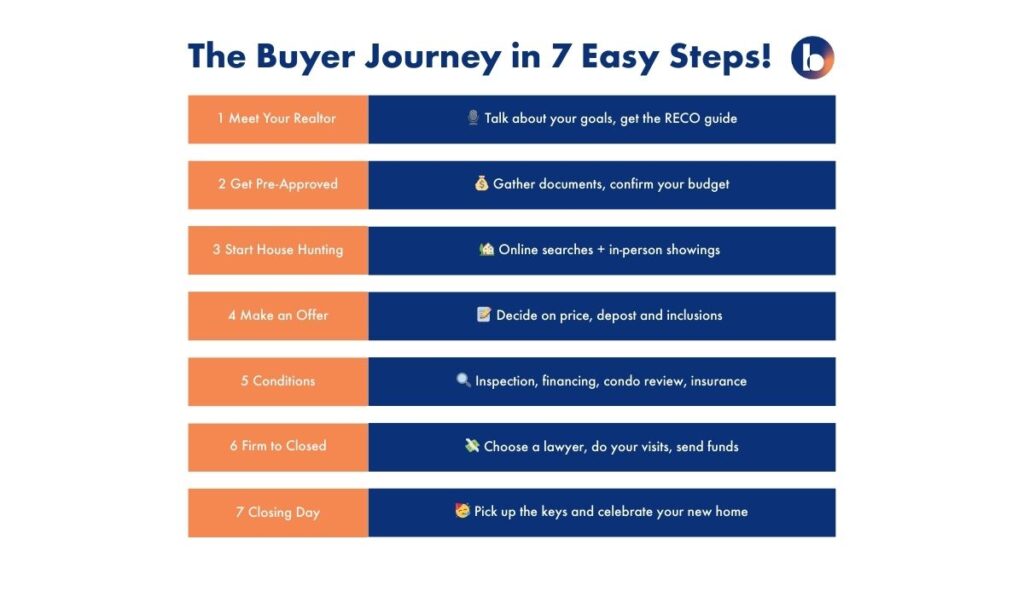
First-Time Buyer’s Guide: From “Where Do I Start?” to “SOLD!”

Uncategorized

Buying your first home is exciting, but it can also feel overwhelming. There’s so much information coming at you from all directions, and it sometimes feels like you’re supposed to just know what to do. We’ve been working with first-time buyers for years, and we know how confusing those first steps can be. That’s why we put this together. If you know someone who’s thinking about buying their first place, share this with them. It might be exactly what they need.


Step 1: Connect With a Trusted Realtor

The first step is finding an agent you trust. Lots of people start with a referral from friends or family. At your first meeting, you’ll talk about your goals, budget, and the type of property you’re looking for. You should also receive the RECO Information Guide, which explains your rights and what to expect when working with a realtor in Ontario.


Step 2: Talk to a Mortgage Professional

If you haven’t already been pre-approved, this is your next move. We often recommend a mortgage broker because they can shop your file with multiple lenders and help you find the best deal.

Be ready to provide a package of documents, such as:


    • Government-issued photo ID

    • Recent pay stubs and T4 slips

    • CRA Notice of Assessments (last two years if you’re self-employed)

    • Employer letter of employment or business financials

    • Bank statements and proof of savings for your down payment

    • Details of other debts (car loans, credit cards, lines of credit)

Your broker usually needs three to five days to review everything and let you know what you can afford.

If you’re using your RRSP through the Home Buyers’ Plan, your broker or bank rep will walk you through the paperwork (Form T1036). When it’s done properly, you can withdraw without tax penalties, but you’ll need to repay the funds gradually back into your RRSP.

💡 Pro Tip: Have your documents ready early
Brokers work faster when you’ve got everything in order. Keep a digital folder with your ID, pay stubs, tax returns, and bank statements. It’ll save you days of back-and-forth.


Step 3: Start Your Home Search

Your realtor will set up an automated home search that delivers listings to your inbox. Remember that these searches only include exactly what you ask for. If your maximum budget is $800,000, the system won’t send you a house at $809,000 even if it might sell for less. It’s often wise to keep your search a little wider and less restrictive.

You can also keep browsing Realtor.ca or other sites. Share anything that interests you with your agent, even a private sale-by-owner, and they’ll dig into the details for you.


Step 4: Book Showings and Tour Homes

This is where things get exciting. Touring homes gives you a true sense of what’s out there. Try to give a little notice when booking, since last-minute showings are harder to arrange if sellers still live in the home. After each showing, your agent can help you review what you saw, compare the price to recent sales, and point out both positives and red flags.

A good agent will often spend more time pointing out why a house isn’t the right fit than trying to convince you to make an offer. That’s because the goal isn’t just to get you into a house, it’s to make sure you find the right home for your needs and your budget.


Step 5: Making an Offer

Once you’ve found the right place, you and your agent will prepare an offer. Together you’ll decide on:


    • Price

    • Closing date

    • Deposit amount

    • Inclusions (such as appliances or light fixtures)

    • Exclusions

    • Other concerns, like whether equipment such as a furnace or hot water tank is rented

You can also ask your agent to find out if the property has ever been used as a grow op, or if there’s been a violent crime or death in the home. Sellers aren’t required to volunteer this information, but if you ask directly, they must answer truthfully.

💡 Pro Tip: Ask about rentals
Furnaces, hot water tanks, and even water softeners are often rented. These costs can add up quickly, so always check what’s owned and what’s not before you sign.


Step 6: Paperwork and Deposits

When it’s time to sign, pay close attention. Never just “sign here and here and here” without knowing exactly what you’re signing. Your realtor should walk you through each page and answer your questions.

Once the offer’s accepted, your deposit is due within 24 to 48 hours. This is often up to five percent of the purchase price. The deposit is held in trust by a brokerage or law office and is protected by insurance.

📌 A Quick Note About FINTRAC

Your realtor is legally required to comply with federal FINTRAC reporting rules (Canada’s anti–money laundering legislation). This means you’ll need to provide government photo ID and details about the account your deposit comes from, including the account number. It’s routine for every buyer and nothing to worry about, but good to know in advance so you’re not surprised when asked.


Step 7: Conditions and Inspections

Common conditions include:


    • Home inspection (typically $400 to $500 -> money well spent 👍)

    • Financing approval for the specific property

    • Insurance approval (for properties with characteristics that could make them hard to insure)

    • Review of condo documents (if applicable)

    • Septic and well inspections for rural properties

An inspection’s meant to uncover major surprises, not to renegotiate over minor issues like chipped paint or outdated items that were obvious on your showings at the property. You should know where your line is for walking away if a serious problem is revealed.

💡 Pro Tip: Focus on the big stuff
An inspection’s not for chipping away at the price over small fixes. Concentrate on big surprises like foundation/structural issues, roof problems, or outdated electrical/plumbing.


Step 8: Mortgage Finalization

Your mortgage broker and realtor will work together to make sure the lender has everything they need. The lender will confirm both your finances and the property value before giving final approval. Once your conditions are satisfied, you’ll sign a notice of fulfillment. At this point, your deal is firm and you’re well on your way to becoming a homeowner. (This is when the SOLD sign goes up and things feel REAL for most buyers! 🏡🎉)


A Note About Today’s Market

First-time buyers are leading the charge right now, especially in the more affordable price ranges. The most desirable properties in this group are beginning to attract multiple offers. It’s not the frenzy of 2021, but you’ll need your agent to guide you through how competition works. Unless you’re a qualified builder, contractor, or engineer, it’s usually wise to keep your financing and inspection conditions in place even in multiple offers.

07.15.2021

Understanding Representation and Your Rights in Ontario

Buyer Basics

Client vs Self-Represented Party (SRP): What Changed Under Ontario’s Real Estate Rules

In everyday language, people often use the words client and customer interchangeably. In Ontario real estate, those words were a source of confusion for many years.

That changed with the introduction of the Trust in Real Estate Services Act (TRESA).

Under TRESA, people involved in a real estate transaction are no longer described as “clients” and “customers.” Instead, you are now either:

  • A client of a brokerage, or

  • A Self-Represented Party (SRP)

Understanding the difference matters. It affects what an agent is allowed to do for you, what they are not allowed to do, and how your interests are protected during a transaction.


What It Means to Be a Client

When you choose to be a client, you enter into a representation agreement with a real estate brokerage. For buyers, this is commonly a Buyer Representation Agreement. For sellers, it is a Listing Agreement.

By signing a representation agreement, you are hiring the brokerage to act on your behalf in a real estate transaction.

Representation under TRESA

Under the current rules, representation may take one of two forms:

  • Brokerage representation, [more common with smaller brokerages] where the brokerage as a whole represents you, or

  • Designated representation, where one or more specific agents within the brokerage are named as your representative(s). [This is the type of representation you will receive from a Remax Escarpment Realty agent.]

Designated representation was introduced to reduce conflicts of interest within brokerages. If you have a designated representative, that individual is responsible for representing your interests. Other agents in the same brokerage must treat you impartially and objectively.


What a Client Relationship Includes

When you are a client, the brokerage owes you specific legal duties.

In plain language, that means:

  • Your representative must act in your best interests

  • They must be loyal to you in the transaction

  • They must keep your confidential information confidential

  • They must avoid conflicts of interest, or disclose them and obtain your consent if they arise

  • They must provide competent, conscientious service

Confidential information typically includes things like:

  • Your motivation for buying or selling

  • The maximum price you would pay or the minimum price you would accept

  • Your negotiating strategy, timing pressures, or personal circumstances

This confidentiality continues even after the transaction ends.


How This Plays Out in Real Life

Being a client allows your representative to give you opinions, advice, and strategic guidance.

That can include:

  • Researching comparable sales to help you price or offer appropriately

  • Advising on offer conditions such as financing, inspection, or sale of property

  • Flagging potential risks that may not be obvious at first glance

  • Negotiating terms and price with the other party

  • Taking reasonable steps to identify and disclose material facts that could affect your decisions

Material facts are things that could reasonably influence whether you buy or sell a property, what price you offer or accept, or what conditions you include. What counts as material can vary from person to person, which is why your representative will ask questions about your plans, lifestyle, and priorities.


What It Means to Be a Self-Represented Party (SRP)

If you are involved in a real estate transaction and do not have a representation agreement with a brokerage, you are considered a self-represented party.

Being an SRP means you are representing yourself.

You are responsible for protecting your own interests, making your own decisions, and doing your own due diligence.

This applies whether you are buying or selling.


What an Agent Can and Cannot Do for an SRP

This is the area that causes the most confusion.

If the other party in the transaction is represented by a brokerage, that agent does not work for you.

Their legal obligation is to their client.

What an agent can do when dealing with an SRP

An agent may provide limited assistance to a self-represented party only if:

  • The agent represents a client in that transaction

  • The assistance is provided as part of serving that client’s best interests [for example, showing a home they have listed to potential buyers]

  • The agent has verified that the person is self-represented

  • The agent has provided and explained the RECO Information Guide and the Information and Disclosure to Self-Represented Party form, and made best efforts to obtain acknowledgement

An agent may also:

  • Provide general real estate information

  • Encourage the SRP to seek independent representation

  • Communicate factual information necessary to move the transaction forward

What an agent cannot do for an SRP

An agent cannot:

  • Provide opinions, advice, or recommendations to the SRP

  • Negotiate on the SRP’s behalf

  • Suggest pricing, offer strategy, or conditions

  • Encourage the person to remain self-represented

  • Discourage the SRP from working with another agent

Anything you share with the other party’s agent that could affect their client’s position may be shared with that client.

That includes your motivation, budget limits, or urgency.


Why This Difference Matters

The difference between being a client and being self-represented is not about paperwork. It’s about who is allowed to protect your interests.

If you are a client:

  • You receive advice, advocacy, and strategic guidance

  • Your confidential information is protected

  • Your representative is legally required to put your interests first

If you are self-represented:

  • You are responsible for your own pricing, strategy, and decisions

  • The other party’s agent cannot guide you

  • You are negotiating with someone who likely has professional support

Some people choose to self-represent because they feel confident handling the process on their own. Others value having a professional responsible for navigating risk, negotiations, and disclosure obligations.

There is no single right choice for everyone. What matters is understanding the difference before you proceed.


Take the Time to Understand Your Options

Before signing anything or sharing sensitive information, make sure you understand:

  • Who represents whom

  • What duties are owed to you

  • What protections you do or do not have

Ontario’s real estate rules are designed to promote transparency. Knowing where you stand helps you make better decisions, avoid misunderstandings, and reduce risk during a major financial transaction.

If you’d like to receive our newsletter with market information for Hamilton buyers and sellers, you can sign up here!

Have More Questions About Buying?

Let us know, we'll be happy to help!

  • This field is for validation purposes and should be left unchanged.

07.9.2021

Market Predictions for 2022 – Who Can you Trust?

Buyer Basics

Don’t you hate it when you have plans and you need a reliable weather forecast?

You know that there’s a 50/50 chance that all the predictions will be dead wrong. You could well find yourself out on a first date at a gorgeous open-air venue, drenched in a surprise rain shower.

As frustrating as it is to deal with inaccurate weather forecasts, though, they’re seldom financially devastating.  Unlike a real estate market crash…


WHAT ACTUALLY HAPPENED IN 2020?

The real estate market defied logic, gravity, and all expectation, if we’re being honest.

When the pandemic started, the whole world retreated – as we needed to do.  We sheltered in place, afraid to leave the houses we were in, never mind think about buying another one.

Despite it all, the average price of a single-family home in the Hamilton/Burlington area went up 30%  between June 2020 and June 2021, according to the most recent update released by RAHB.


THE MILLION DOLLAR QUESTION: Where’s the Real Estate Market Going Next?

As with the weather, there is no shortage of forecasters for the Hamilton real estate market (and the Canadian real estate market, for that matter.)

Since the net worth of a majority of Canadians is tied to their real estate, many of us need to know what’s happening in the market to protect our own finances.

Consumers are, understandably, reluctant to rely on what they see as biased sources of information.  Who can you trust?

The way we see it, it makes sense to look to those whose predictions were accurate in the past.  So…who got it right last year – during one of the most unpredictable and unprecedented global events in our lifetime?

Let’s take a look:


CMHC – Canadian Mortgage and Housing Corporation (Got it OH, so wrong!)

This Crown Corporation provides an important service to first-time buyers who have down payments of less than 20%.  As a government agency, part of their mandate is to provide unbiased research into the housing market.

Since they insure mortgages, they have to manage risk.

What did they predict for last year?

  • In May, 2020, CMHC issued a special edition of their Housing Market Outlook.  They pointed out that the pandemic “introduced unprecedented uncertainty to economic and housing outlooks.”

At the time, their predictions seemed logical:  The market could be expected to see a historic recession.  Prices would fall between 9-18%, and recover only in the first half of 2021.

Interestingly, CMHC stuck to their guns longer than they probably should have – insisting that the market would sour before the end of the pandemic.

They even briefly instituted some new rules in July, 2020 to try to protect home buyers from getting into financial trouble. (They reversed these measures a year later.)

See what CMHC forecasts for the coming year. (They are much less pessimistic about the market this year, in case you’re wondering.)


RBC – Royal Bank of Canada (They really tried, and they got a couple of things right!)

RBC is also intimately involved with the real estate market as a major mortgage provider.  As lenders, they need to strike a delicate balance between getting new business (which means letting people buy properties) and minimizing their own risk.  It’s in their best interest to come up with accurate forecasts.

What did they predict for last year?

“We believe the scale will tip in favour of buyers in many markets across Canada and (benchmark) prices will fall modestly, possibly as early as this summer.”

To their credit, the same report acknowledged that the shift to work-from-home could drive higher demand in markets outside the major urban areas.  That part was entirely accurate!

RBC forecast for the coming year. (The word that keeps coming up is “affordability.”  And not in a good way for buyers.)


CREA – Canadian Real Estate Association (They had their finger on the pulse in July.)

CREA is the national organization that ties together Canada’s 78 real estate boards.  They work to provide accurate information and analysis to the public, based on country-wide statistics and trends.

How did they do in 2020?

“There were only 3.6 months of inventory on a national basis at the end of June 2020 – a 16-year low for this measure.”

This statistic means that, at the current rate of market demand, if no more listings came up for sale, it would take only 3.6 months for there to be zero supply left.  To create a buyer’s market requires six months of supply.

What does CREA think of the upcoming year? (They say urgency is fading, but look for the paragraph that says 19.3% price increase and only 2 months of total inventory.)


REMAX – Top Real Estate Brokerage in Canada (Restrained optimism as early as May.)

Everyone recognizes the Remax balloon. Wherever you go in the world, you’ll know their signs.  Surely, all that market share and experience counts when making predictions.

When predicting how the pandemic would affect Hamilton’s real estate market, Remax was cautiously positive and tried to keep a balance in their forecast.

Here’s what Remax said about the market in May 2020.

Ever working to be local experts, the brokerage pointed out some past events that could have threatened our local market at the time:

“During the 2008 financial crisis, home prices and sales volume rose within Hamilton. The outcome was similar during the 2003 SARS public health crisis; the market remained strong, and there is little evidence that there was any impact on local real estate during the outbreak period.”

In early May 2020, Remax maintained that ‘it was likely that the current trends of creeping prices and healthy demand would prevail.’

See what Remax thinks will happen in the year to come.  (Encouragement for buyers and reassurance for homeowners and sellers – the ideal forecast for 2022.)

So Who Do You Trust?

As much as it makes sense to be skeptical of “biased” sources, sometimes it makes sense to listen to people who are closest to the action every day.

Sure, the weatherman studied meteorology and has a fancy degree.  But if the guy standing outside with boots on the ground is dripping wet and telling me it’s raining, I tend to believe him first – no matter what the talking head on TV is saying.

Let’s get some cliches out of the way:  None of us have a crystal ball (go ahead, groan with me), and Anything can happenOK, we’re done.

But reliability is built over time. And it makes sense to turn to the sources that have been accurate in the past.

As always, timing the market shouldn’t be the primary or the only factor in decision-making when it comes to your home.  Your personal circumstances, finances, and comfort level are truly the priority in a decision this big.

If you’d like to stay “in the know” about your local area, whether you’re planning to buy and sell, we’d be glad to make sure you get the latest information in your inbox every morning. Send us a quick message with the area you’re interested in and a little info about they type of property you’re curious about.  We’ll set up a customized search just for you.

Click here to request your neighbourhood updates.  


Want to stay in the know?

Sign up for our Newsletter!

  • This field is for validation purposes and should be left unchanged.

07.2.2021

3 Hamilton Patios We Will Be Enjoying This Summer!

In The Community

We’re so excited to be entering, not only Stage 2 of re-opening, but also Patio Season!! It’s been a long 16 months of restrictions.

Eating out is always a treat.  It’s one of the things we’ve missed most during this strange and solitary year-gone-by.  At this stage in Ontario, we can once again enjoy outdoor dining for up to six people. Woot woot!

Hamilton has a thriving food scene and offers options for every mood.  Whether you’re craving comfort food or healthier options, whether you’re vegan or carnivore – you can satisfy your tastebuds here in the city.

To celebrate the reopening, we want to share Hamilton patios that we recommend to visit this summer:


CIMA ENOTECA

“Love love love this restaurant. Wood fire pizza oven makes for some amazing pizza… and highly recommend the cacio e Pepe!”

Since we’re partial to traditional comfort food, this one is first on our list.  Their 5-star online reviews are not an accident.

Being restricted to the patio means we won’t get to fully enjoy the open kitchen with its gorgeous wood-fired pizza oven in all its glory.  But that’s ok for now.

The stuff that comes out of that kitchen is what will keep you coming back!

A peek at Cima Enoteca’s menu will make your mouth water. (You know the food is authentic when the menu is written in Italian!)

From classic pizza and fresh pasta dishes to elegant seafood stew and truffle-adorned “strozza,” there’s something for everyone.  Be sure not to skip dessert – who doesn’t love good Sicilian cannoli?

And if you have a designated driver, we hear the cocktails are pretty great, too.

Check it out at 190 Locke St S.  For reservations, call 289-389-5848 or book your table at Cima Enoteca online here.


NAMU RESTAURANT AND BAR

“My wife and I always love eating here. Great service and I legit want to order the entire modern Asian menu every time we sit down! If you haven’t been to Namu in Dundas. Do yourself a favour and treat your tastebuds!”

Though it couldn’t be more different from Italian fare, Namu is another Hamilton (Dundas) gem whose stark raving fans write glowing Google reviews.

Korean food is some of the most satisfying, filling, delightful cooking you will ever try.  And Namu provides that.

But we love them for their personality, too!  The home page of their website announces that they’ve taken a “staff vacation” and will re-open on July 2.  Amazing!  We love that they take care of their staff.

And the menu is cheeky enough to bring a smile to your face before you even have a plate in front of you.  No doubt for the sake of locals who’ve never had the pleasure of tasting this particular Asian cuisine, they’ve added a touch of North Americanism to the names of their dishes.

Will you try the Seoul Poutine (there are russet potatoes in here, so it counts!)?

Maybe you prefer the more carnivorous-sounding Spicy k.f.c. (no copyright infringement if you use lower-case letters, right?).  That stands for “Korean Fried Chicken,” by the way.

Or if you appreciate the ultimate fusion, perhaps you’ll want to try the Sushi taco. 

Having turned their parking area into outdoor dining space, the ambiance might not be what it was when we could sit indoors, but the sacrifice is worth it.

Before 2:00 pm, you can make reservations by email at namumodernrestaurant@gmail.com.  After that, you’ll need to phone in – 289-238-8738.

Namu is located at 186 King St W in Dundas.


FIRTH’S CELTIC PUB

“My wife and I went for afternoon apps yesterday. The bartender/waitress was incredible and handled everything and was so kind! The food insanely good and the portions were massive. We will definitely be back!! Highly recommended!”

If you’ve been missing your fix of chicken wings, fish ‘n’ chips, or other staples of the pub food menu – you’ll love Firth’s.

Patrons of this Hamilton Mountain eatery at 543 Upper James St. will tell you that the friendly staff is a huge part of the appeal, too.  They follow the hospitable tradition of the playwright named Johnny Firth, whose concept for an Irish pub was discovered in the heart of Manhattan.

Even with current COVID-era limits in place, your group of six or fewer can leave the stress behind and enjoy a meal together, sharing a plate of Irish Nachos (or regular nachos, your call).

Add a pint of Guinness for the whole, authentic Irish experience. Or, honour a bit of trivia from the bottom of Firth’s menu and order yourself an India Pale Ale because, as they point out:

“IPA STYLE :: In the late 1700s, every man in the British armed forces was rationed on gallon of ale per day. As a result, India Pale Ale was specially formulated in the late 1700s to survive the long voyage from England to thirsty British regiments stationed in India during this period. An IPA also indicated a superior ale, worthy of export.”

Interesting, right? If you’d like a reservation, call 905-318-HARP(4277).

Hamilton, like the areas around us, is carefully starting to open up.  Stay safe, protect your health, and take precautions – but do enjoy your summer, hit up our recommended Hamilton patios, and support some local businesses as you are able!

06.18.2021

Real estate is an excellent investment. Always has been.

There is even a school of thought that says that as soon as you pay off your own mortgage, you should take the money you had been spending on it and put it straight toward a rental property.

This might be good financial advice . . . but are you ready to be a landlord?

Easy Money?

It sounds like the ultimate in passive income:  Let the tenants pay down the mortgage while your equity builds.

Except being a landlord is not a hands-off or no-skills-required job.

It involves work, and you will absolutely require help for at least some of it.

Landlord Responsibilities

Here in Ontario, residential tenancies are regulated by the Residential Tenancies Act, 2006.  (There are a few exceptions that can be found here.)

Outside the listed exceptions, all tenants (since May, 2018) are entitled to receive a copy of the Ontario Standard Lease.

It’s important to know that there is such a thing as an illegal, or unenforceable, clause.  A landlord cannot contract out of a responsibility or restrict a tenant’s lawful right by adding clauses to the lease.

For example:  A landlord cannot evict a tenant for having a pet, even if they have a “no-pets” clause in their lease.

Here are some other basic responsibilities that are not negotiable:

Provide legal documents without charge:

It is up to you, as the landlord, to provide a copy of the tenancy agreement, if you have one, with the Ontario Standard lease.  You must also issue rent receipts to the tenant upon request.

There are also standard forms for you to use when notifying a tenant of rent increases, landlord visits to the rental unit, or eviction.

Repair and maintain the home:

The landlord is responsible to make needed repairs, even if the tenant was aware of them before signing an agreement.  Some of these will involve repairs to heating, plumbing, electricity, and appliances that come with the unit.

The law also requires that you comply with all provincial/municipal health and safety standards.  This includes providing and maintaining working smoke and CO detectors in all rental units.

Tenants are responsible for damages that they cause to the unit.

Access to vital services:

A landlord can’t legally shut off utilities (electricity, natural gas, water), even if the tenant doesn’t pay the rent.

In some cases, you may arrange for tenants to pay the utility companies directly.  However, if they don’t pay, you may ultimately find the charges added to your tax bill.

Heat:

In Hamilton, the by-law requires that tenants have adequate heat between September 15 and May 15.  The landlord must ensure that the temperature doesn’t go below 20 degrees Celsius.

Common Area Maintenance:

Cleaning and maintenance of common areas is always a landlord responsibility.

This means common hallways or shared spaces, as well as lawns and driveways.

Many tenants agree to cut the lawn and shovel the snow, but if they decide to stop or become unable to do it, the landlord has to make arrangements to take care of these tasks.

Calculate the True Cost

It’s important to protect your investment – and a little due diligence can help you avoid serious financial hardship.

While making your plans to buy a rental property, remember to factor in vacancy, maintenance, and repairs.

The main recurring expenses will be your mortgage, taxes, insurance, and utilities, unless your tenants will be paying those directly.  Make sure, though, that rents cover these with a little left over to put toward a slush fund for the inevitable repairs that will come up.

Figure out how long you could carry the property if it became vacant or the tenants stopped paying rent.  It’s not uncommon for the eviction process to take more than a few months.

Remember, too, that rental income has to be declared as income and that it is taxable.

Finally, if you are considering a single-family home with a secondary suite, be sure to investigate whether it’s legal before counting on renting it out.  If it isn’t, find out what the cost would be to make it so.

You can read more about creating a legal rental suite here.

Professional Services You Might Use

If you’re considering becoming an investor, chances are that you already have a busy life and career.  You probably don’t have time to be on call 24/7 for tenant issues, handyman work, lawn or snow maintenance, etc.

Before buying your first property, look into the cost of different companies to handle those maintenance items.

We also highly recommend that you speak to an accountant who can help you to structure your finances and taxes in a way that allows you to keep as much of your profit as possible.

Property managers can be a lifesaver if you have a very hands-on rental property that requires a lot of attention.

The Hamilton and District Apartment Association (HDAA) is a local resource where you can find support and education on matters of interest to landlords in this area.

At the very least, read through the Landlord Tenant Board (LTB) site to get familiar with the provincial laws that will apply to you as the owner of a residential rental property.

Your Success is Around the Corner

As long as you arm yourself with the right information, you can succeed at building an income-generating portfolio.  Real estate is still an excellent investment.  We want to help you to invest wisely so that you get the most for your efforts!

Ready To Buy a Rental Property?

We can help! Leave you info below and we'll reach out!

  • This field is for validation purposes and should be left unchanged.

06.11.2021

House Hunting Checklist for Buyers continued…The Basement

Buyer Basics

This week, we’re continuing with our house hunting tips for buyers in a sellers’ market. (If you missed last week’s post about what to look for on the outside, you can catch up here.)

Buyers and their agents are still dealing with restricted showing times, usually 30 minutes or less.  Be sure to use that time to look for red flags – signs that the house you’re viewing could have expensive issues.

Just to repeat the important part:

There is absolutely a measure of risk involved in buying any house. This is as true of new construction as it can be of a ‘handyman special.’  Things can go wrong, and previously unknown issues can crop up at any time.  Every homeowner will have maintenance and repairs to do at some point.

You can do a few things to avoid big surprises. It’s possible to sharpen your eye for signs of problems on your first visit to a property.  You’ll have to make the best use of your visit, though – looking past the cosmetics of the property – no matter how beautifully staged it is!

Let’s head inside the house and take a careful look at the basement.

Is a Wet Basement a Big Deal?

You might have heard people comment that a “damp basement” in an old house is “not a big deal.”  Let’s put a pin in that thought and come back to it.

Literally everything about the exterior of a house, from the roof to the windows, the siding, and the parging on foundation walls, is there to keep water out of the house.  Despite what seem like best efforts, though, sometimes water does get inside.

In any house, but especially one with a finished basement, water intrusion can be destructive.  In an old house with damp air, you could find that your metal tools or appliances rust over time.

If you see a dehumidifier, chances are that there is moisture that needs to be controlled.

Dampness at the right temperatures (60-80 degrees F/15-27 degrees C) also provides the perfect environment for mould to grow.  The health hazards of mould overgrowth are well known.

So why would anyone minimize the importance of a wet basement?  This probably goes back to the days when houses were built to different standards.  It was normal to have air leaks through drafty windows and gaps in door frames.  Insulation wasn’t as efficient, and there was much more air flow.  Back then, if a small amount of water got in, it easily dried itself up and it really wasn’t a big deal.

Things have changed – our homes are tighter, warmer, and more comfortable now.  But that also means they need to be drier, since moisture doesn’t evaporate as easily.

So, yes, a wet basement is something to watch out for – it can be a very big deal.

wet basement


What to Look For in the Basement: Moisture and Flood Control

We’ve already discussed the role of grading and downspouts in keeping the water away from foundation walls.  But if that doesn’t do the trick, there are some interior things that can protect the home.

There are some things that show that problems have been dealt with:

Not all houses need or have one, but look for a sump pump in the basement.  In areas with a high water table, a sump pump can take care of some excess water by pumping it away from the house.  It sits in a pit in the lowest part of the house where water collects.  During a heavy rainfall or snow melt, when the water gets past a certain level, the pump will go on and drain water through a discharge pipe.

What you don’t want to see is a sump pump that is always running, or a sump pit that is full to the top.  This could mean that there is more water than the pump can handle and you will need to find another solution.

Another thing you might see in some houses is an interior drain system.  If the basement is unfinished, you’ll be able to see where the concrete floor was cut to create a trough around the perimeter for a drainage tile.  There will also be a dimpled membrane along the wall(s).  The system will direct water into the sump and keep your basement dry.  It’s usually a good sign to see this type of waterproofing!   If you see that only one or two walls have been done, though, look carefully at the others.  Water looks for the weakest entry point – so check to ensure there is no dampness elsewhere.

You will find a device called a backflow valve in some Hamilton homes as well.  These are installed to prevent contaminants from flowing back into the house from outside. (There is an excellent explanation of backflow valves here.)  Hamilton has a rebate program that pays up to $2000 to homeowners who have them installed.

There are clues that some issues are ongoing:

You should also keep an eye out for signs that there is a problem that still needs attention.

Water stains, rust on surfaces, efflorescence (white salt-like staining), and, of course, actual moisture are all cause for concern.  Pay special attention to exterior walls.

Ask questions if you see drywall that’s been partially cut out from the floor around the perimeter, exposing the studs.  This could mean there was a flood or even a sewer backup.

Last, but not least, check for signs of mould.  Your nose may be the first to pick up on the distinct musty smell, even if you don’t see anything.  Not all smells are sinister mould infestations, but you should always investigate if you have any doubt.

Look Up

In unfinished basements, take some time to inspect the ceiling joists.  The integrity of these literally holds up the house, so it’s important that they are not weakened.

Look for joists that have been cut or notched, for ones that are separating at the fasteners (nails/screws), or that are twisting.  If you see evidence that someone has damaged them, it’s wise to get a qualified contractor’s opinion on what you would need to do to make it right.

If the house was built before the 1940’s, or sometimes a little later, you can sometimes see old knob and tube wiring by looking up, too.  You’ll know it by the distinctive ceramic knobs and tubes.  Sometimes, they’re just remnants of a system that’s been updated.  But if you see any wires passing through these pieces, ask questions.

K & T is very outdated, can be a fire hazard if it’s brittle, is ungrounded, and can be an issue for insurance companies.

And while we’re on the topic of wiring…..

ceiling joint


Electrical Panels

You will find these in the basement most often, so they’re worth a mention.

Unless you are qualified to do more, the closest you should get to an electrical panel is to open the front door.  Never touch the sides or any metal part that is connected to a wire or any of the screws!

For those of us who are not electricians, we will stick to the basics.  Are there fuses or breakers?  Any panel that still has fuses is outdated.  It might be fully functional and working fine, but it’s no longer the standard.  Count on replacing it with a breaker panel.

Some fuse panels in older homes (prior to 1960) are only on 60 amp service.  This could cause trouble when you try to get insurance on your home, as most insurance companies consider this “high-risk,” and some will not insure them at all until they’re upgraded.  (Remember, without insurance, you will not get a mortgage…so this is a real concern.)

There are 100-amp fuse panels as well, and these are better – still outdated – but possibly a little easier to insure.  Our best advice is to call your home insurer to see what their policy would be for a home with this type of electrical panel.

Look for the main breaker.  You may see two parts to the switch that are connected to each other, each with a number on them. This is a two-pole switch – and you do not add the values.  If each one says “100,” you likely have a 100-amp service coming in.  A 200-amp service would have a two-pole switch, with “200” printed on each side (pole).

You can try to identify aluminum wiring by looking at the casings on the wires leading to your panel.  Sometimes, you can see “AL,” “ALUM,” or “ALUMINUM” printed on the cable sheathing.  As with other outdated components, insurance companies don’t love this type of wiring.  Most that do offer coverage will charge a premium.

electrical panel


Plumbing

This is another component that you can see best in an unfinished space.

We could say a lot about the plumbing systems inside a house, but in the half-hour you have for showings these days, you can look for a few things that might need attention.

Especially in older homes, look for cast iron drain pipes.  Although these were solid and long-lasting, they had a life expectancy of 80-100 years.  This means that homes built in the 1930’s and 1940’s, if they haven’t had a plumbing update, are due.  The last thing you want is to have a leak in your drainage stack that could’ve been prevented.

Other outdated plumbing systems include lead pipe and galvanized pipes.   We now know that it’s not healthy to use lead that could get into our drinking water.  And galvanized pipes corrode from the inside.  Water flow will be reduced, which can be annoying.  But the pipes also disintegrate, meaning that they could burst unexpectedly and cause damage.  The current standard is copper or pex.

Here are the tricks to determining what type of water supply pipe you are looking at:

Use the flat edge of a screwdriver to scratch the outside of the pipe.

  • If the scraped area is shiny and silver, your service line is lead. A magnet will not stick to a lead pipe.
  • If the scraped area is copper in colour, like a penny (you remember pennies, right?), your service line is copper. A magnet will not stick to copper, either.
  • If the scraped area remains dull gray, and a magnet sticks to the surface of it, your service line is galvanized steel.
pipes

Ready to Go Upstairs…

Once you’re satisfied with what you see in the basement, you can head up to admire the upper levels of the house.  We’ll cover that next time!

*We would like to extend a huge THANK YOU to Don Dell – Instructor and  Creator of the CRSE Course for realtors.  His input and expertise is invaluable to us as we work with our clients to find the right home!


Looking to Buy a Home?

Leave your info below and we'll reach out! ????

  • This field is for validation purposes and should be left unchanged.

06.3.2021

House Hunting Checklist for Buyers! Exterior

Buyer Basics

The market is shifting… ever so slightly.  Buyers finally have a little more inventory to choose from.

It’s still a seller’s market, though – which means that many offers are going in firm, without conditions.  You, dear Buyer, may have rock-solid finances and have no problem without a condition on financing.  Without a home inspection, though, and with only 30 minutes total time at the house you want to buy in many cases- how can you protect yourself?

There is absolutely a measure of risk involved in buying any house.  This is as true of new construction as it can be of a ‘handyman special.’  Things can go wrong, and previously unknown issues can crop up at any time.  Every homeowner will have maintenance and repairs to do at some point.  When you’re buying a first home, this can be especially unsettling.

You can do a few things to avoid big surprises.  It’s possible to sharpen your eye for signs of problems on your first visit to a property.  You’ll have to make the best use of your visit, though – looking past the cosmetics of the property – no matter how beautifully staged it is!

Let’s review our house hunting checklist that can look at to help you decide whether a house is worth considering.  First, we’ll talk about the exterior.

BEFORE GOING INSIDE

The exterior of a house can tell you a lot about its overall condition.  Without having to become a certified home inspector, you should be paying attention to a few major things:

Roof:

In Southern Ontario, the most common roofing material will be asphalt shingles. Stand back from the house and look at it from the sidewalk.  Most of us can tell quickly if shingles are missing, lifting, curling, or otherwise approaching the end of their useful life.  Sometimes, if you look at the edge, you can see two or even three layers of shingles – which is less than ideal and can cause trouble with any insurance claims or inspections.

Besides the obvious, though – look for buckling or sagging in the roofline. Don’t ignore these signs of potential structural weakness.

Or maybe you can see moss or other greenery growing out of the roof.  This is not the way to get a rooftop garden!  Investigate further before pursuing a house that has this happening.

Flat roofs are a bit tough to assess from street level but, fortunately, they are also fairly rare on residential properties.  If you are looking at a home that has an unusual roof that could be more expensive to repair, it might be a good idea to have it inspected before you put in your offer.  And when buying a first home, try to stick to more common rooflines so that your expenses can be a little more predictable.

roof

Pro tip! Always look at the south facing side of the roof. This side takes the brunt of the heat and will age the quickest. It will give you a better idea how much life is left before the roof will need replacing.

Gutters & Downspouts:

Downspouts are the vertical pipes that carry rainwater from the roof and eaves troughs away from your house.  Start by looking for downspouts that are extended away from your foundation walls.  Ideally, these will discharge onto the lawn or into a rain barrel.

Sometimes, you’ll see downspouts connected to a drain pipe that goes below grade.  Hamilton is one of many municipalities that encourage disconnection for many reasons, including protecting your foundation walls.

Gutters are the horizontal pipes along the edges of your roof that carry rainwater to the downspouts.  Look up to see the condition of the gutters:  Are they plugged up and overflowing with leaves? Are they bent or misshapen in a way that prevents water from flowing freely? Are they otherwise damaged – or missing entirely?  This simple component of the roofing system does the important job of managing the path of water around your home.  They are not usually expensive to repair or replace.  However, if they’re left in poor condition for a long time, there can be serious damage to the house, deck, and gardens.

For best efficiency, you can visually estimate whether there are enough downspouts to carry the load.  The rule of thumb is that there should be a downspout for every 35-40 feet of gutter.  If you’re buying your first home and gutters are the biggest issue you find – that’s a win!  With the right professional to get things made right, they’re a relatively easy fix.

gutter

Exterior Walls & Foundation

As you walk around the outside of a house, you’ll also want to take note of the condition of the exterior walls.  The parts of a home that are exposed to the elements are particularly vulnerable to water damage, and some repairs can become very expensive.

There are problems that can only be properly diagnosed by an expert, but it’s wise to be aware of signs that you can see to let you know you should call one in.  Most types of exterior cladding will get damp, even if just from condensation that results from temperature differences.  What’s really important is that the moisture has somewhere to escape.

Brick homes should have some version of weep holes for ventilation and drainage.

Vinyl or aluminum siding require flashing for drainage to be integrated with some sort of material that forms a water-resistant barrier behind it.

Stucco-like exterior finishes also need somewhere for the water to drain.  The most common system you’ll find is a stucco weep screedThis is a specially made piece of metal flashing that draws water out the bottom of the wall.

You will probably not be able to see all the measures that the builders have taken to prevent water damage.  What you may see is evidence of damage that’s already there.  If you see signs of efflorescence (white salt residue from water that has evaporated), swollen wood, or other deterioration on the exterior, there’s a good chance that something isn’t right.

cracked exterior wall

When checking the foundation walls from the outside, not every crack is cause for concern.  Pay special attention to deep, horizontal cracks, though – as well as vertical or step cracks that are wider at one end than the other, since those may indicate structural instability.

Decks & Porches

You might be surprised to learn that most decks require a permit.  Still, you will see many that have clearly been added without one – and some that are downright dangerous.

Before stepping out onto a deck or porch, especially a high one, check that railings are secure and that deck boards are sound.  You don’t want to find yourself stepping through a rotted board.

Any looseness in the structure could mean that the entire deck was improperly fastened to the house.  To be safe, deck framing must be secured to a structural component of the house – usually floor joists – with the proper hardware.  There needs to be adequate support beneath the deck, too.

It may be impossible for you to see the screws, nails, or joist hangers – but you will definitely see it if the support posts are not anchored, if they are too small, or if they are not there at all.  Check around the bottom of the posts.  Do you see rot or deterioration? Are they set in concrete?

Finally, pay attention to climbing hazards for children.  Built-in benches or cross pieces in decorative railings can look great. But they are not safe unless there is enough height above the top of the highest point to prevent a child from climbing over.  The minimum railing height should typically be 36 inches.  If the deck is six feet or more off the ground, that requirement becomes 42 inches.

stained deck

Don’t rush…

It’s tough to be thorough in this age of hurried showings that last 30 minutes or less.  Regardless of the market, though, a house is a huge purchase.  Especially if you’re buying your first home.  See if you can arrange a second visit or a pre-inspection if you are serious about a property.  Try to see the inside first and look more carefully at the outside as the next showing begins.

Check back soon for some things you can look for once you get inside …!

*We would like to extend a huge THANK YOU to Don Dell – Instructor and  Creator of the CRSE Course for realtors.  His input and expertise is invaluable to us as we work with our clients to find the right home!

Looking For Help Through the Buying Process?

Leave your info below and we'll reach out!

  • This field is for validation purposes and should be left unchanged.