Getting started on the path to homeownership often feels harder than it should.
For many renters, the hardest part of moving toward ownership is not the idea of buying a house. It’s figuring out where to start.
Beyond “saving up,” there’s a long list of unknowns. When do you talk to a lender? What questions actually matter? How do you know whether a price makes sense, or whether you’re stepping into the market at the wrong time and overpaying? And how do you move forward without feeling rushed or underprepared?
That uncertainty is often what keeps people stuck, even when they’re motivated and financially responsible.
Turning rent into something you can measure
We’ve tried to break down the math in a way that helps renters who want to transition into ownership see what their current housing costs could realistically support.
Not as a promise or a qualification. Just as a planning tool.
By translating rent into ownership numbers, it becomes easier to understand what goals make sense, what steps come first, and what might need more time.
Getting a few things out of the way
This article isn’t for everyone.
If you’re happy renting, value flexibility, or prefer to invest your money elsewhere, that’s a completely valid lifestyle choice. Renting works well for many people, and there’s no universal rule that says owning is better.
That’s not the conversation here.
This is for people who want to own a home someday and feel overwhelmed by how far away that goal can seem. It’s for renters who are trying to understand what their current housing cost actually translates into, and what steps might move them closer to ownership over time.
There’s no attempt here to debate renting versus owning, or to convince anyone they should buy. The goal is simply to make the numbers clearer.
Surveys consistently show that this goal is still very common. One study found that 84 percent of Millennials and Gen Z believe owning a home is a worthwhile investment, and about 54 percent of current renters plan to buy within the next five years.
If ownership is the goal, concrete numbers help.
The down payment comes first
For most would-be buyers, the down payment is the biggest hurdle.
With the cost of living where it is, saving extra money can feel unrealistic. Some people build a down payment slowly through savings. Others use RRSPs, inheritances, or gifts from family. There’s no single right source. What matters is having some amount set aside.
In Canada, five percent is the minimum down payment required, but larger down payments improve affordability and flexibility. If you don’t yet have funds earmarked for a down payment, that’s the first goal on the road to ownership.
At this stage, the focus should be simple and realistic:
- Build a budget that reflects your actual life
- Set a savings target that feels achievable, not punishing
- Treat the down payment as a medium-term plan, not an overnight leap
Without this step, everything else stays theoretical.
Talking to a lender clarifies the picture
Once there is a down payment fund in place, the next step is talking to a lender.
This is often delayed longer than it needs to be. A conversation does not mean committing to a purchase. It simply means finding out what you could be approved for and whether that price range aligns with what’s actually available in the market.
That clarity is valuable. Some people discover they are comfortable with the options at that level. Others realize they’d rather wait, save more, or adjust expectations.
Approval is information, not pressure.
Using rent as a reference point
If a renter qualifies for an amount similar to what they are already spending on rent, the chart below helps translate that monthly budget into ownership.
It shows how a rent payment might look if it were applied to a mortgage, while also accounting for property taxes and home insurance. Utilities are intentionally excluded, since renters typically pay those already.
These numbers are estimates. They are meant to help people visualize the relationship between rent, down payment, and purchase price. They are not exact quotes or guarantees.
The chart is best read as a range, a reference point.
What happens over time
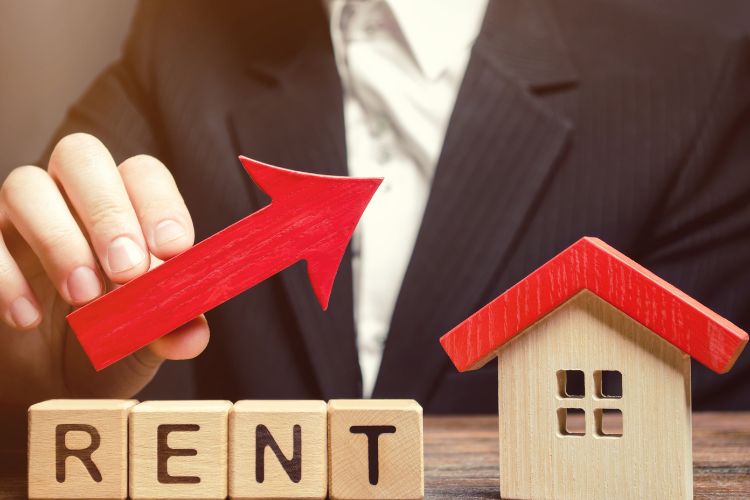
Rent rarely stays flat. Even modest increases add up over time.
If rent starts at $2,500 per month and rises by 2 percent each year, the change can feel small at first. In year two, rent increases to about $2,550. By year three, it’s roughly $2,600. By year four, it’s closer to $2,650. By year five, monthly rent is around $2,700.
Usually, none of those jumps feel dramatic on their own. But over a period five years, they add up.
Across that five-year stretch, total rent paid would be just over $156,000. That’s the cost of housing during that time, with no portion building equity.
Ownership works differently.
While mortgage payments include interest, a portion of each payment goes toward principal. In a typical middle-of-the-road ownership scenario, that principal repayment adds up quietly in the background. Over a five-year period, it’s common for tens of thousands of dollars of equity to be built simply through regular payments, even without assuming any increase in home value.
This comparison isn’t for the sake of predicting markets or trying to time things perfectly. It’s an exercise in understanding how time affects each housing choice.
Rent increases gradually raise future housing costs. Ownership tends to stabilize payments while slowly shifting more of each payment toward equity.
When renters can see both sides laid out clearly, decisions feel less abstract and more intentional.
Many potential buyers wisely waited out the market at its height and just kept saving toward their eventual purchase. If you’re still renting, but would like to own your own home, your opportunity may have arrived! The market is definitely yours to explore in 2026.
What Your Rent Could Support Toward Ownership (Estimated)
Monthly Rent vs Estimated Purchase Price
| Monthly Rent | Down Payment | Monthly Mortgage Budget* | Approx Mortgage Size | Approx Purchase Price |
|---|---|---|---|---|
| $2,500 | 10% | $2,017 | ~$384,000 | ~$410,000–$420,000 |
| 15% | $2,017 | ~$384,000 | ~$445,000–$455,000 | |
| 20% | $2,017 | ~$384,000 | ~$480,000 | |
| $2,750 | 10% | $2,267 | ~$432,000 | ~$460,000–$470,000 |
| 15% | $2,267 | ~$432,000 | ~$490,000–$500,000 | |
| 20% | $2,267 | ~$432,000 | ~$540,000 | |
| $3,000 | 10% | $2,517 | ~$480,000 | ~$510,000–$520,000 |
| 15% | $2,517 | ~$480,000 | ~$545,000–$555,000 | |
| 20% | $2,517 | ~$480,000 | ~$600,000 |
*Monthly mortgage budget = rent minus estimated property taxes and home insurance.
If you’d like to talk to a mortgage professional without any pressure at all, let us know. We work with some excellent partners who can give you a clear picture of your options and help you talk through the next steps on the road to homeownership.