
When a home doesn’t sell as quickly as planned, confidence starts to waver. Sellers feel frustrated and stuck. Buyers get suspicious and nervous.
Most of the time, the reason isn’t mysterious. It’s visible once you know where to look.
When a property takes longer than expected to sell, here’s what we actually look at.
1. What Did We Already Know Before Listing?
If it’s our listing, we go back to the preparation stage.
Before we ever hit the market, we’ve already discussed:
- The basement that’s shown moisture
- The kitchen or bathrooms that feel dated
- The roof or furnace nearing the end of its life
- The layout that won’t suit everyone
- Any structural issues that will require real remediation
Nothing about those things or other similar issues surprises us later on.
If the traffic to the home slows down, we revisit the list. Is negative feedback lining up with one of those known friction points?
Occasionally, this explains the delayed sale.
2. Where Is It Positioned on Price?
This is always part of the review.
Buyers shop in ranges. They compare three or four properties at a time and decide where they feel comfortable stretching the budget.
If a home is sitting slightly above where it naturally fits, it ends up competing with stronger options. That’s when activity slows down.
We look carefully at:
- Recent comparable sales
- Current competition
- How long similar homes are taking to sell
- Whether buyers in that price range are active right now
Accurate pricing should reflect positioning in the current market. An overpriced listing where emotion factored in often misses out on early qualified buyer traffic.
3. What’s Happening Around It?
From a buyer’s perspective, this is where most of the clues show up.
We get calls like this all the time:
“I see this one’s been on the market for a while. Do you know why?”
And that’s a fair question.
The first thing we check is what comparable homes are doing.
Are similar properties selling?
Are they moving faster?
Are they priced differently?
Are they updated in ways this one isn’t?
If similar homes are moving and this one isn’t, there’s usually a specific difference you can identify once you line them up side by side.
If nothing comparable is selling, that tells you something about buyer activity in that bracket.
4. What Does the Price History Say?
The listing timeline often tells its own story.
- Price reductions
- A re-list at a new number
- A property that launched high and adjusted later
We look at how the seller is responding.
Are they adapting as the market gives feedback? Or are they holding firm despite slower movement?
That affects negotiation dynamics. A seller who is willing to adapt may be more motivated than one who holds firm.
5. Is It Cosmetic, or Is It Structural?
This matters, especially for buyers.
Some issues are surface-level:
- Paint
- Flooring
- Dated finishes
Others are permanent:
- Backing onto commercial areas
- Heavy traffic exposure
- Zoning limitations or negative neighbourhood influences
- Ongoing water problems
A home can sit because it needs work. That can be opportunity for one buyer and a pass for another.
But if the hesitation is tied to something that can’t be changed, the market tends to reflect that consistently.
The Common Thread
When a property lingers, it isn’t random.
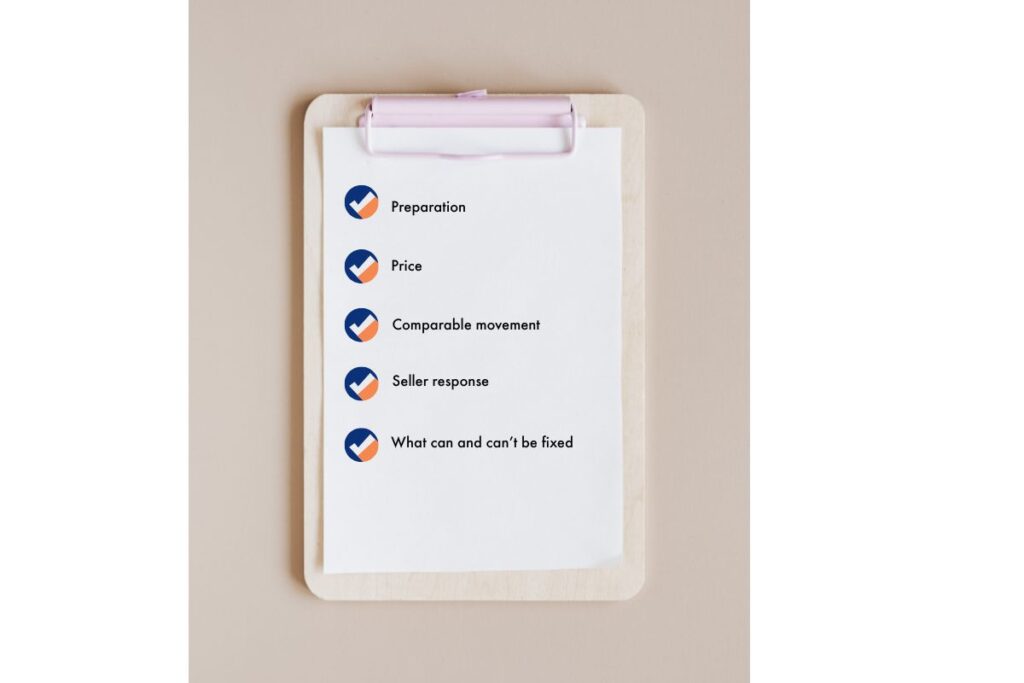
We look at preparation.
We look at price.
We look at comparable movement.
We look at seller response.
We look at what can and can’t be fixed.
The market leaves signals.
Even in slower conditions, some homes receive multiple offers. Buyers who are ready still act. Sellers who position their property appropriately still move forward.
When a home isn’t selling, we don’t have to speculate. We examine the facts and decide what needs to shift.