Does a neighbourhood with these distinctions appeal to you?
Most or every city has a neighbourhood (or two) that represent success. One of those in GTA West is Mineola or Ancaster in Hamilton.
WHAT TO LOVE ABOUT MINEOLA
Described as one of the “ultimate ‘move-up’ neighbourhoods just west of Toronto, Mineola is a tranquil, picturesque community in the south end of Mississauga. Average home prices can be up to 63% higher here than in the rest of Mississauga. Some consider the area to be part of Port Credit.
Mineola is a lush part of southern Ontario with agricultural roots. However, by the 1960’s, the QEW highway, new subdivisions, and GO train service arrived. These changes transformed the area into a residential enclave.
An affluent community, Mineola boasts some of the best public school rankings in the area – a major draw for many families.
You will find some truly spectacular homes on oversized lots here. There is a beautiful blend of new custom builds, stately older homes, and sharp urban townhouses on the tree-lined streets. Pride of ownership is on full display, and residents who make Mineola home tend to make deep roots – some that last for generations.
Practically speaking, this area is convenient for its access to highways (connecting to Toronto) and proximity to Port Credit’s shops, restaurants, and recreation options.
One of the criteria for many home buyers with unlimited budgets is to be close to water. On this front, Mineola is rich: Cooksville Creek and the Credit River both run through and drain into Lake Ontario, whose shores are walking distance from anywhere in the neighbourhood.
WHAT HAMILTON OFFERS: ANCASTER
For native Hamiltonians, Ancaster represents much of what Mineola embodies to Mississaugans. It is a neighbourhood set apart, and the barrier to entry is a higher-than-average family income.
There is stature attached to an Ancaster address – one that attracts white collar professionals and financially successful entrepreneurs. Buyers are willing to pay a premium to move to the area. Options here include large, sprawling properties in Old Ancaster, newer construction in Meadowlands on smaller lots, and luxurious townhouse developments that are becoming a very popular option for busy professionals.
Like Mineola, Ancaster has an agricultural history. To celebrate its roots, the Ancaster Agricultural Society holds an annual fair at the Fairgrounds located on 62 acres at the corner of Garner and Southcote Roads. More local pride is showcased in Ancaster Village. Quaint shops, a seasonal farmer’s market, and tours of historical buildings offer a glimpse of bygone times before industry and six-lane highways and modern construction took over.
For all its changes, one thing is constant through the ages: The breathtaking natural beauty of the Niagara Escarpment on which Ancaster grew up. The Iroquoia Heights Conservation Area connects to the Chedoke Rail Trail or toward Tiffany Falls, and each area offers dazzling views of preserved natural elements. Ancaster’s waterfalls are its answer to Mineola’s river, creek, and lakefront. As part of Hamilton, the City of Waterfalls, Ancaster is home to many: Sherman Falls,Ancaster Heights Falls, Canterbury Falls, Shaver Falls, Washboard Falls, and Mills Falls – to name a few. A number of these falls are on private land, but the owners graciously allow access to view their majestic allure.
More than a few families have stretched their budget to ensure that their children could qualify to attend Ancaster High School, an International Baccalaureate School of distinction.
COMPARING THE COST
The cost of living in Ancaster is well above that of the original City of Hamilton. However, it is still affordable when compared to Mineola. The average sold price of a Mineola home as of December, 2020 is $2.1 million.
In Ancaster, the average detached home with three or four bedrooms ranged from $893,000-1,200,000.
Are you considering a move to take advantage of the equity in your prime Mineola property? You will be pleasantly surprised at the value you can expect in this very similar neighbourhood!
For a little more about Ancaster neighbourhoods, click here.
If you would like more information about Ancaster’s real estate options, we would love to be of help! Let us know what we can do for you.
By now, you have probably heard that at least one lender (HSBC) is offering a mortgage rate under 1%. It’s safe to say that this is unprecedented, but what does it really mean for buyers?
Without getting into whether ultra-low rates are good for the economy in general, we can state with confidence that home buyers who need a mortgage usually welcome low interest rates. If you are considering buying property, how much should the current lending rates affect your buying decision?
Who Qualifies for 0.99% Right Now?
It’s important to clarify that this latest rock-bottom rate is only available to a relatively small group of buyers. The offer is for high-ratio insured mortgages, that is, for buyers who have less than 20% down payment. This is the same group who pay a premium between 2.8 and 4.0% to insure their mortgage with CMHC or a similar insurer. Lower rates will definitely help offset that premium but, according to James Laird, co-founder of RateHub.ca, the 0.99 offer only targets about 10% of the current potential home buyers.
Another factor to consider is that this is a variable rate. The mortgage term is for 5 years, but the interest rate will fluctuate with the market – usually in response to the Bank of Canada’s rate changes. For most people, the variation will not break the bank – since the stress test is still in place to ensure affordability.
First time buyers out shopping for a mortgage should definitely check out this offer in the course of their research!
What About the Rest of the Buyers?
For the other 90% of potential home buyers, including move-up buyers, and even home-owners looking to re-finance, there are still very low rates available. Many lenders are offering rates under 2%. It’s not unheard-of to see rates under 1.5%.
As always, your personal credit history, your income source and reliability, and the size of your down payment factor in to the rate you ultimately will pay. Your relationship with the lender may also work to your advantage. A long-time client of a banking institution may see the best offers available.
What Do Interest Rates Mean For Your Bottom Line?
Let’s take an example of an average Hamilton home. A first time buyer with 10% to put down on a $600,000 property can take advantage of the HSBC offer. Here’s how a 25 year mortgage would look at this 0.99% rate:
Down payment: $60 000
Mortgage amount: $556 740
Mortgage insurance premium: 3.10%
Total mortgage insurance: $16 740
Total mortgage interest: $71 810.33
MONTHLY PAYMENT: $2095.17
To qualify for this mortgage, buyers must pass the aforementioned stress test, to ensure that they could withstand a rate increase up to 4.79% (which, by the way, is still a historically reasonable interest rate compared to the 20+% in the 1980’s!)
At 4.79%, this same purchase would look like this:
Down payment: $60 000
Mortgage amount: $556 740
Mortgage insurance premium: 3.10%
Total mortgage insurance: $16 740
Total mortgage interest: $394 798.30
MONTHLY PAYMENT: $3171.79
As you can see, interest rates matter.
But House Prices Are Rising Too Fast!
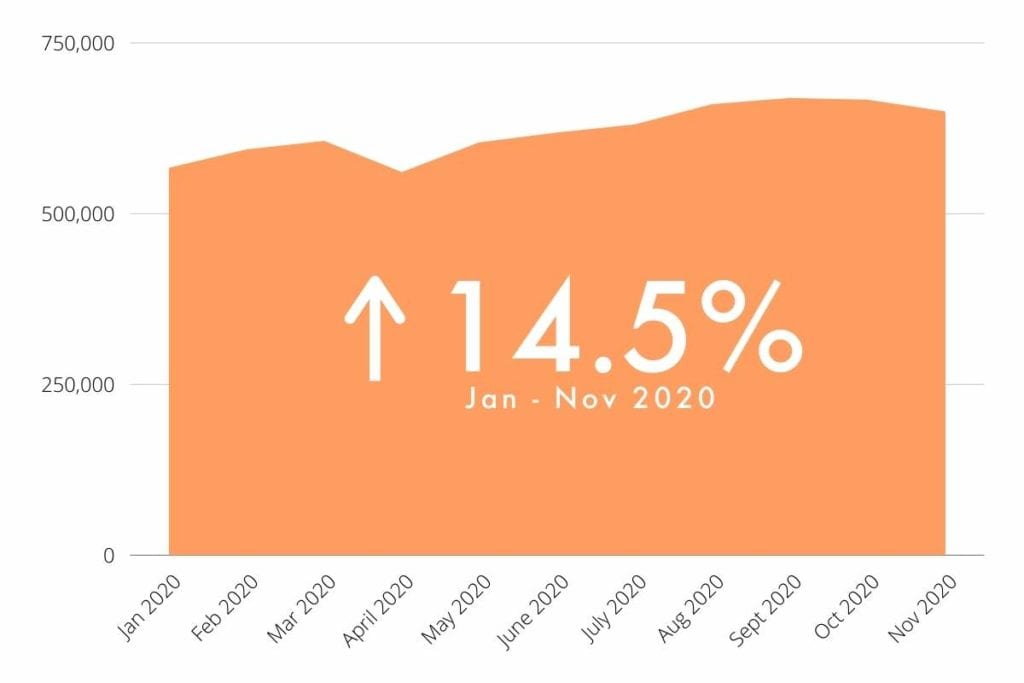
In the Hamilton-Burlington region, statistics for November 2020 showed a year-over-year price increase of 24.4%! Even with house prices rising, though, monthly payments are staying low.
Prepare to be amazed at how this price increase over last November, when a well-qualified buyer could get rates around 2.5%, has affected monthly mortgage payments for first time buyers:
Assuming that a $600 000 house was worth 24.4% less one year ago, the first time buyer would have paid $482 315. Let’s do the math, shall we?
At 2.5% interest, their mortgage would have broken down this way:
Down payment: $48 231
Mortgage amount: $451 447.36
Mortgage insurance premium: 4.0%
Total mortgage insurance: $17 363.36
Total mortgage interest: $155 252.16
MONTHLY PAYMENT: $2022.33
The difference in monthly payments between buying a $480 000 house in 2019 and a $600 000 house in 2020 is approximately $72.84. Mind blown, right?
This helps explain why the market has supported such rapid price growth.
How to Use Low Rates to Your Best Advantage
We know that rock bottom interest rates can’t last forever, and certainly not 25 years to allow buyers to finish paying off a typical mortgage. How can you make the most of this period of cheap borrowing that we are seeing now?
Most mortgage lenders have what they call “pre-payment privileges.” They will allow you increase your monthly payments and/or make a lump sum payment in addition to your regular payments once or twice a year. If you can budget to pay down your mortgage in this way, the extra funds you put toward the debt go straight to the principal amount. This directly reduces your balance owing. In five years, when you renew your mortgage at the terms available, even if rates are up, you will be borrowing much less.
It’s also important to calculate the true cost of home ownership. Be sure not to set yourself up to be house poor – don’t just buy at the top of the budget allowed by your lender. Analyze your finances to make sure you can cover all your living expenses and have a little left over. That way, you’ll have room for slightly higher payments when the time comes.
To help you calculate the cost of different mortgage options and ways to save for your first home, here are some handy calculators:
If you need help to figure out your options in the current market, or if you have other questions, call or drop us a line anytime. We are here to help!
Looking to Take Advantage of the Low Interest Rates?
Leave your details below and we'll reach out! ????
When you need a reliable prediction of what to expect in the upcoming year, it makes sense to pay attention to those with a good track record of accurate forecasts. 2020 has challenged even the most skilled prognosticators. Who had it right? And what does a clear view of the 2021 housing market look like?
How Do “They” Make Their Predictions
Trend watchers and industry insiders use the data they have to make forecasts. They also have to factor in intangible factors, like consumer confidence. One way to measure this is by frequent polling. For example, the BNCCI [Bloomberg Nanos Canadian Confidence Index] does weekly surveys of Canadians to assess the ‘economic mood’ of real people.
We can crunch all the numbers we want, but it is real live people who buy and sell real estate. That’s what makes this indicator so powerful.
Of course, the emotional mood has to work alongside the economic and practical data to form an accurate forecast of what is to come. So what other information helps us paint a real picture of what to expect?
Though some statistics can apply across the country, the more localized the data we use, the more relevant it will be to our current market. We will focus on the Hamilton-Burlington Board area, which includes information about Burlington, Niagara, Haldimand County, and Brantford.
Supply and Demand: The Inventory Story
As with every service and commodity, housing prices respond to the balance between supply and demand. In other words, if there are more buyers than sellers, prices rise.
This is what we are seeing on a daily basis. It is a rare listing that does not attract multiple offers. Buyers compete for available properties, and many sell for over asking price throughout our region.
One metric that we use to determine the slant of the market is months of inventory. This is the number of months it would take for all currently listed properties to sell if no new listings were to come onto the market.
When we divide the total number of homes for sale by the total number of homes sold in a month, we will get one of three results:
A seller’smarket is indicated when we see four months, or less, worth of inventory.
A balancedmarket is when we see between four and six months of inventory.
A buyer’smarket is when we see six months of inventory or more.
As of December 9, 2020, there are 2068 active residential MLS listings, including both freehold and condo units of all sizes in the following areas:
Brantford
Hamilton
Haldimand
Niagara
Burlington
In the preceding 30 days, the same areas saw firm sales of 2274 units. These numbers indicate that current inventory stands at 0.91 months. If no new listings came onto the market, all units for sale today would be sold in less than one month. That is a very strong seller’s market in these regions, with demand far outstripping supply.
Some of the demand is coming from move-over buyers. The pandemic has motivated a segment of Toronto buyers to move to outlying areas. Now that they can work from home, commuting distance is less of an issue than ever before.
The decline in the Toronto condo market is part of the demand story. We are seeing buyers who want more space moving farther out from the city’s centre, and taking their buying power with them.
Hamilton, Burlington, and parts of Niagara also offer living that compares well to many Toronto neighbourhoods, albeit on a smaller, less expensive scale. Some city-dwelling buyers dream of a tranquil country property. They now find that they can afford to have everything they want while working from comfortable home offices outside the GTA. Popular areas for this type of buyer include Binbrook, West Lincoln, Port Colborne, Lincoln, or Haldimand County. The appeal to our region is easy to understand.
The shortage on the supply side is partly due to home owners who are putting their plans to sell on hold.
Several things factor into the decision to postpone selling. Some of these are: health concerns, fear of having strangers in the house, job and economic uncertainty, and conflicting predictions for the coming year.
The option to defer mortgage payments in the spring of 2020 allowed many home owners to keep their homes through a temporary period of unemployment. (September 30 was the last day to apply for deferrals, and anyone who remained unemployed after that time may soon be forced into a position where they must sell.)
Home owners also realize that, though it will likely be a breeze to sell at a good price, they will face a different scene as buyers. Bidding wars, rising prices, and a shortage of good options discourage some from listing, keeping supply tight.
Analysts and Statistics…
PwC (PricewaterhouseCoopers), an international firm that provides data/analytics and consulting services, acknowledges conflicting trends that are emerging in its 2021 Outlook For Canada’s Housing Market. On the one hand, there is the move away from urbanization. The pandemic has created a shift in our collective mind-set, fueling the desire for more independent space and the ability to isolate in comfort. On the other, there is the demand for urban-style options where work/live/play elements are the priority. Time will tell whether the migration away from large cities will be a permanent change.
Though unemployment is still higher than it was pre-pandemic, a large number of Canadians have been able to get back to work – bringing the unemployment rate down from a high of 13.7% in May to 8.5% in November. Signs point to a modest recovery, which will likely be accelerated if and when a vaccine becomes widely available.
We can’t neglect to mention historically low mortgage rates, as low as 0.99% for first-time buyers. For as long as borrowing is cheap, demand is likely to remain high.
What New Construction Tells Us
New housing starts are a carefully monitored indicator of demand as well. CMHC tracks activity in the construction of new residential units across the country. You can find Ontario statistics here.
This sector of the market is also growing at a healthy pace, slightly up from last year’s numbers. Housing “starts” are counted when footings or foundations are installed for a new residential unit. This could be any type of property, from detached to multi-family dwellings, such as apartments.
The latest available data for Ontario measures the year-to-date numbers as at the end of October. The YTD starts this year are 65,577, up from 57,292 at the same time in 2019.
Completions of residential units are also up – 55,426 as of the end of October, 2020, compared with 45,971 in 2019.
We can attest to the fact that demand for pre-construction and new builds is very high. Competition can be as fierce here as it is for resale/MLS listed homes. Sales offices are struggling to keep up with the number of appointment requests these days.
Our Thoughts
We work with buyers and sellers every day, and we see the reality of the strong seller’s market that the numbers verify. It may make no sense, with our economy suffering from the effects of a global pandemic, and with many small businesses under intense pressure. At the beginning of 2020, we certainly would not have been too confident that the real estate market could thrive as it has.
Now that we have come through the past nine months, we have the benefit of hindsight. We see the human indicators that tell us that real people are very invested in their home as a safe haven. Canadians have always valued real estate as an investment. But this year has reinforced our desire to have a comfortable, multi-purpose, safe, place to call home.
One sad fact that is clearer than ever is that lower-income earners are the segment of the population that is most affected by the economic downturn. Many of those whose jobs are affected by the health crisis are renters. [Rents are down in 2020.]
Professionals and other white collar workers who can work from home, as well as skilled tradespeople and other essential workers are still earning steady income. These make up the majority of home-buyers, and they are driving the market.
The Bank of Canada released a statement on December 9 to confirm that it will maintain the interest rate at its current low to encourage economic recovery. This means mortgage rates are likely to stay very affordable.
Seller’s Market Here to Stay for a While
Based on all the factors we can measure, it looks very much like our real estate market will continue to grow. When some experts were predicting gloom in 2020, Remax was much more optimistic, based on detailed knowledge of market activity. The 2021 Market Outlook is similarly positive.
For the record: We would love to see a little balance return to the market. We look forward to seeing our buyer clients have a little more leverage and negotiating power. However, for the foreseeable future, it looks like sellers will continue to reign supreme.
Remax was right in 2020. This is what they say about 2021.
Some of you may already know that one member of the Brandow Group is a happy transplant to Hamilton from the GTA. The move was such a good one that we are now advocates with a reputation for trying to entice friends and family to come and enjoy the city (and its affordable real estate) with us!
Lest anyone think it’s all about selling houses, though – we have reached out to some clients who moved in 2018, and we asked them to share their experience moving south down the QEW to our beloved new hometown.
Katherine and John are a professional couple who chose to retire to a beautiful enclave on the Hamilton Mountain after living in their stately High Park home for decades. They were kind enough to write down their thoughts after living here for the past two years:
Katherine says:
“After raising our family and working in the west end of Toronto for many years, we were ready to find a new home and a new location to retire to. We had a great community there with good schools and medical facilities and enjoyed the many parks, the sports facilities, music venues, the subway, and lots of restaurants. The diversity, vibrancy, and inclusivity of Toronto was so very wonderful but also the city was growing at an almost unrecognizable pace.
Hamilton has offered us very similar diversity, vibrancy, and inclusivity. We are impressed with the number of lovely older homes and established neighbourhoods, opportunities to enjoy theatre and music, top notch schools like McMaster and Mohawk, and great doctors and hospitals. There is also lots of activities and support for seniors which is very much appreciated. Hamilton is a city that also allows you to escape to beaches, trails, and farmland quickly and easily. It seems as though anything we could need or want is nearby by car or walking.! Life is good in Hamilton, the people have been warm and welcoming and we would recommend a move here wholeheartedly.”
We are so grateful to our lovely clients for sharing their experience with us.
If you’ve been wondering about Hamilton…
If life has changed for you, and you’ve been considering whether a move out of Toronto would suit you, we would be delighted to give you a tour of some Hamilton options. Please feel free to send us any questions you have and we will help any way we can!
We are all feeling it in one way or another. There is anxiety over health concerns, job insecurity, and major life decisions.
For many home owners, there is a sense that the economy could dip, taking much of their real estate equity down with it. And that’s a scary thought, especially for people who are approaching retirement age.
Is the Market Going to Crash?
Ah, the million dollar question…and in the Toronto market…maybe more than a million!
The truth is, even the most skilled expert can only guess what is going to happen to the real estate market.
Back in 2017, some well-respected analysts boldly predicted that the market would fall 28% by 2020. In hindsight, that was a needlessly pessimistic forecast.
Here we are in 2020. At the height of COVID uncertainty, Evan Siddall, the CEO of CMHC, lambasted realtors and others within our industry in May. He asserted that anyone who claimed house prices would rise was, essentially, a bad actor looking to do you harm. This, while Remax remained confident in the strength and growth of the Canadian market.
Either forecast could have been accurate. So many factors combine to motivate buyers and sellers that it is impossible to predict exactly how and when the tides will turn. At the time of this writing, it is the beginning of December.
As this crazy year winds down, any home buyer will tell you that competition has been fierce, inventory has been tight, and home values continue to rise. Mr. Siddall’s skepticism (and cynicism) were somewhat premature, apparently.
Having said all that, we know that real estate (like other markets) moves in cycles, and that corrections do occur. We can only follow trends and look for signs of change in the short term. For now, buyers still outnumber sellers, and for as long as demand outpaces supply, the upward trend continues. When we see that shift toward balance, with more listings available and fewer buyers competing, we will know that things are starting to cool down.
How Will I Know When to Cash Out?
We are hearing from more and more people that they are considering selling their homes and renting a place in order to protect the equity they have built. They fear that we are in the peak of the market and they don’t want to lose any money. It may make sense for you to cash out now, but there are a few questions you need to ask yourself before making your decision.
Where will you go?
Are you thinking of exiting the market entirely to rent a place? Or are you looking to downsize into a smaller home? Do you plan to stay in your own neighbourhood? Or are you ready to move to a less expensive area?
Right now, in Hamilton and the surrounding area, downsizing can be a challenge. Smaller, lower-priced homes are in high demand. Investors compete with first-time buyers and downsizers for the same pool of properties, and that drives prices up. Be sure to explore your options before selling your larger home. Make sure there is enough margin to make it worth the move.
If you are looking to move out of the city to a place where the cost of living is much lower, that will likely make downsizing a more profitable decision. Be sure to research house prices with the help of a local expert in your desired area. Once you know how much house you can get for your money, you will be in a better position to crunch numbers and decide if relocation is the way to go.
Rental rates in Hamilton have remained the same since last year, with the average 2-bedroom apartment renting for $1438. Detached, 3-bedroom houses listed on MLS range from about $1800-2800/month, depending on area, size, and amenities.
If, after figuring out your net proceeds from the sale of your property, you feel that you have enough to feel comfortable renting at these prices – that may be the direction you choose to go!
What stage of life are you at?
There is a difference between hedging your bets in your 20’s and 30’s and reducing your exposure as you approach retirement.
Older home owners whose mortgage is paid off and who are depending on the equity in their home for their retirement fund may choose to cash out now.
We strongly recommend that you discuss your plans with a qualified financial advisor. They can offer suggestions for the best way for you to invest the proceeds from a house sale. Be sure that the equity you have now is enough to provide the standard of living that you desire. If you’ve done the research and you feel comfortable taking your profits – now might be a good time.
Some younger home owners speculate that the market will drop. Their plan is to sell now and buy low later on.
If you are considering this, you might want to think a little longer about your decision. That plan could very well be a money-maker – and your speculation could turn out to be spot-on. However, it’s important that you consider all the implications.
Are you at risk of losing your job? This is a practical question that does not, alone, determine whether selling your home is the right decision. For some, job loss would mean an inability to keep up with mortgage payments. If this is your situation, selling might relieve stress and give you more room to weather a financial storm. Remember, though, if you use the money from the sale to cover living expenses, you’ll have to save up a new down payment from scratch when you’re ready to re-enter the market.
On the other hand, if you have income from a side-hustle or small business that could cover your living costs, it might be wise to hold on to your property. Mortgage lenders look less favourably on the self-employed. You might find it hard to get the best rates if you sell and try to buy again in a year or two with only your small-business income.
If the fears of a falling market do materialize, a period of recovery will follow, as it always has in the past. Interest rates will eventually rise, making mortgage money more expensive to borrow. Be sure to factor in the cost of borrowing later on!
History shows that, despite dips in the market, real estate values trend steadily upward over the long-term. The question really is this: Is your house primarily your home, or do you see it strictly as an investment? Since you will always need a place to live, there will always be some expenses attached to keeping a roof over your head. Does the cost of renting save you enough to warrant selling an asset that is likely to continue to increase in value? If so, then cashing out may be a good decision.
Selling your home, your largest investment, is a huge decision at any time.
When considering a major life change, get as much information as you can – and take time to consider all your options. We would be happy to help you research values in your neighbourhood and to point you in the direction of other professionals who can help you decide whether now is your time to sell!
Delta/Gage Park is (statistically) mainly comprised of single family homes, owned by married couples with older children. Recent trends indicate that many younger families with children are moving to the area. We are also seeing many homes being renovated, built on, or converted in to duplexes. Singles make up a significant 24% of the population. White collar residents represent the majority, with primary employment in business, finance, and administration occupations, along with sales and service sectors.
GREAT STUFF YOU’LL LOVE
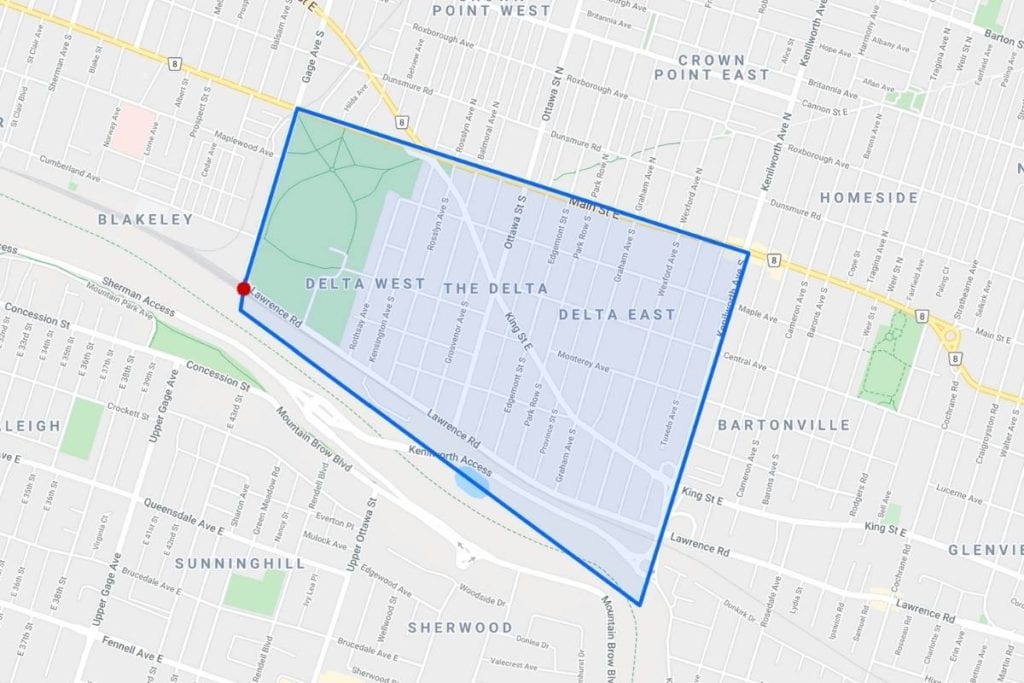
Delta/Gage Park outer boundaries are Kenilworth Ave. South, Lawrence Rd, Gage Ave., and Main Street. This beautiful pocket of older homes is nestled closely to the Escarpment and enjoys spectacular views of seasonal foliage.
Gage Park, located on the western edge of the community, is a neighbourhood anchor that attracts visitors every day. Dog walkers, parents & children, cyclists, seniors, and anyone looking for a peaceful breath of fresh air can be found there. In addition to the day-to-day quiet foot traffic, there are weekly concerts and festivals all summer long. The park features fountains, play grounds, lawn bowling, tennis clubs and community gardens. In 2019, a new greenhouse was constructed in the park that is home to many exotic plants from all over the world. Admission is free for regular visitors, but you must purchase a $190 permit from City Hall if you would like wedding photos at this spot. (For photos inside the Greenhouse, contact City Hall for additional info.)
Delta/Gage Park is also home to many schools (including French Immersion), transportation, and Ottawa St shopping district. Homes in this area are often very well cared for and full of character.
NOT SO GREAT STUFF
There isn’t much to dislike about the Delta Neighbourhood, unless you need a very large home, prefer a new build, or are looking for a condo. Typical homes are 2000 square feet or less, and there are no condos to be had. There are also train tracks running along the base of the Escarpment. Although the train runs very slowly and is relatively quiet, some may not like the sound if located very close.
High school students will need to travel to Bernie Custis School now that Delta Secondary School has closed.
Also, if you are looking to be close to nightlife action, this may not be the place for you.
FAVOURITE SPOTS THE NEIGHBOURS LOVE
Gage Park is definitely the highlight of the area. It’s a great place to visit all year round.
The Bruce Trail – This famous trail runs right along the escarpment.
Delta is a well-established, family-friendly neighbourhood for people looking to enjoy time outdoors. It appeals to folks who wish to be close to shopping and amenities, while not living downtown. There is plenty of street parking in comparison to many other older areas in Lower Hamilton. Property values have increased approximately 75% in the past 5 years – a rate slightly higher than the municipal average.
Loyalty to a neighbourhood can run deep. Everyone believes that the other guys live on the ‘wrong side of the tracks,’ and that their own ‘hood’ is the place to be.
But what makes the perfect neighbourhood? Is it schools? Conveniences? People? It depends who you ask!
For home buyers who are looking to relocate to Hamilton from an ideal Toronto neighbourhood, the standards are high. Toronto is a vibrant, world-class city that has something for everyone.
We have strong confidence that, although you will make time to visit after you move, you will feel at home here in ‘The Hammer’ much more quickly than you expect!
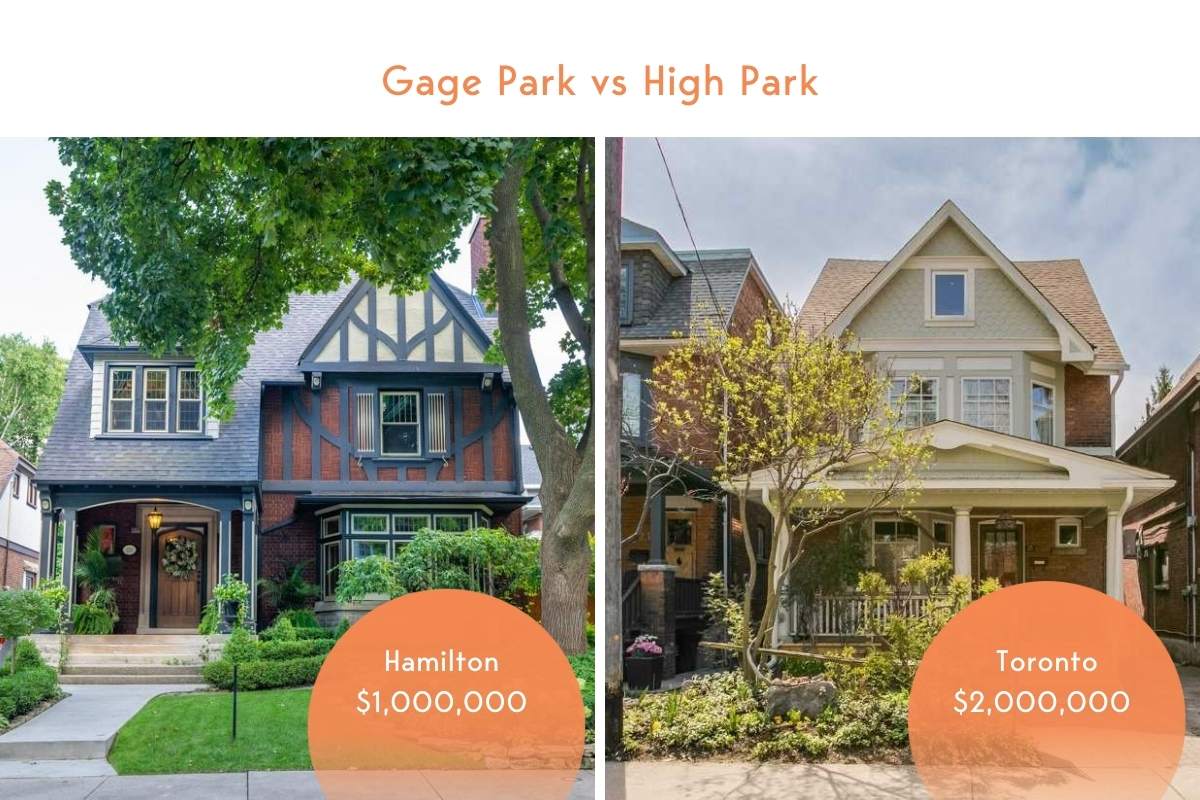
Today, we will focus on a much-loved neighbourhood in Toronto: High Park. If High Park is your favourite area of Ontario’s capital city, where might you hang your hat in Hamilton?
Much to Love About High Park
To state the obvious, High Park – the actual park – is the jewel of the area. Dog walkers, solo walkers, joggers, bikers, anyone else on wheels, and nature lovers of all kinds spend time taking in the tranquility of High Park. This is Toronto’s answer to NYC’s Central Park. Sprawling over 400 acres of purely preserved nature right in the middle of the city’s concrete-themed urban living, High Park offers hiking trails, water features, a playground, towering trees, even tennis courts and a museum.
Famously every spring, in late April or early May, the Sakura trees put on a show as the cherry blossoms bloom.
Besides the park itself, though, the sense of community in High Park is important to residents. Residents include young families, well-heeled professionals, and renters who pay a premium for small suites in the densely populated neighbourhood.
Streets are lined with character homes, many of them beautifully updated, some subdivided into apartments. Mature trees enhance the area.
This is urban living outside the downtown core, with easy access to transportation, amenities, and conveniences. A one-bedroom apartment in Toronto in 2019 rented for around $2250. (A major shift in the economy has shown a 20% drop- the average rental costs $1800 as of November 2020.)
To own real estate, though, is different. The median price in High Park North for October, 2020, you would have needed a budget of $1,266,000!
What Hamilton Offers: Gage Park
We believe that, if you are at home in High Park, you will fall in love with Hamilton’s Gage Park.
Though much smaller than High Park at 71 acres, Gage Park encompasses many similar natural features: tranquil walking trails, massive trees and sprawling green spaces, two playgrounds, a splashpad, and a museum (on the site of the original homestead – just like High Park’s Colborne Lodge).
The focal point of the park is its water feature: the 300-foot long watercourse and fountain that provides a place for quiet relaxation as well as a backdrop for stunning photos.
The Rosedale Tennis Club at the park offers multiple playing surfaces and year round indoor courts.
Gage Park is also home to a perfectly manicured rose garden that blooms at summer’s peak, and a 14,000 square-foot (1,300 square metre) tropical greenhouse. Admission is free, and a walk through the greenhouse is almost as good as a vacation!
The newest installation in the Park is the Pump Track, a BMX-style track where kids, young and old, can work on their skills! Initiated by local Crown Point Youth Council, the track is popular with riders of all skill levels.
On a daily basis, area residents walk, jog, and bike the trails – with or without dogs – enjoying the breath of fresh air provided by the green space nestled in the city.
Gage Park Area Neighbourhoods
The houses east and west of the park are predominantly character and century homes. There is variety among them in size and style, including legal, non-conforming duplexes with second-storey auxiliary units. Most of the buildings display the timeless beauty of the red brick that was once baked locally at Hamilton’s Century Brick on Lawrence Road.
Transit is easily accessible along the main arteries around the park. Though not heavily commercial, there are convenience and grocery stores scattered throughout the area. Ottawa St. N., with its shopping district and abundant dining options is just a stone’s throw away.
The area’s demographic mirrors High Park also in that it includes a mix of higher-earning professionals and low-rise renters who may be just starting out. Families with young children have flocked to the area in recent years, many of these choosing to restore and renovate beautiful old homes.
These neighbourhoods, together, have created a sort of urban living with a suburban feel in Hamilton’s east-central district. And although property values have risen quickly over the last few years, you will be pleasantly surprised to learn that it takes much less that $1,266,000 to own a fully renovated character home here!
Check out some recent sales below. When you’re ready to find your dream home at a fraction of what you would pay in Toronto, we’ll be here to help 🙂
Ready to Move to Hamiton?
We're here to help! Leave your details below and we'll reach out.
You’ve likely heard that term before. When considering a purchase as large as a house, it can be unsettling to think that the onus is on you, the buyer, to know all the right things to look for and questions to ask. Add the craziness of a super heated market and lack of opportunity to include “normal,” protective conditions in your offer, and the stress mounts rapidly!
We’ve seen thousands of homes over the years and have helped hundreds of clients protect themselves from buying a money pit.
During your search for a home, here are 11 questions you should ask (preferably in writing) to ensure that you have all the information you need to make a good decision.
1. Are there any latent problems with the home?
A “latent” defect is “a fault in the property that could not have been discovered by a reasonably thorough inspection before the sale.”
It’s important to ask this question because even if you have the opportunity to include a home inspection, inspectors cannot tear walls apart to see problems. Inspections are “visual inspections only” and will not likely turn up a problem only the seller knows about. If the seller agrees (in writing) that there are no latent defects to their knowledge, this adds protection if you discover an issue down the road. If you include this in your offer and the seller refuses to sign it, the red flag they raise might save you from buying a problem.
2. What improvements have the owners completed? Was a permit necessary? Was one obtained?
Once you own a property, you own all the problems with it. Hence the importance of knowing some history about any improvements that have been done. A seller who has done extensive renovations without permits may have inadvertently damaged the structure in ways that will be very expensive to fix.
As a buyer, don’t be afraid to ask who did the work. Was it DIY on Saturday afternoons, or were projects completed by professionals? If the seller removed walls and didn’t get a permit, you cannot be sure it was done correctly.
3. Have there been any leaks? Basement? Roof? Plumbing?
This falls under the “latent defect” question above, but it often helps to ask a more specific question to get the owners thinking. Water leaks are among the most dreaded issues because they are expensive and intrusive to remedy. Few things are more demoralizing than discovering a water leak in the basement that ruins the finishes. The even bigger question might be whether mould remediation is necessary.
4. Why are the sellers moving?
This question is more than just being a busybody into their personal lives, and there is no guarantee that they will tell you the whole reason, since many people do have multiple personal motivations.
The sellers may, however, give you some insight into issues that are important to you: Perhaps there are no children in the neighbourhood for their kids to play with. Maybe there is new construction coming that they don’t want to live through. Or maybe they don’t get along with the neighbours.
We actually had one experience not too long ago when we asked this question. The seller replied that she was raising two young sons who were approaching their teens. She decided to move because “the hookers hang out at the end of our street every night,” and she didn’t really want her sons to grow up in that environment.
Though maybe not the most consequential question, you could get information that helps you to decide whether this location is right for you.
5. How is the neighbourhood?
If you get little from asking them why they’re moving, this question may feel less intrusive, and get you more of the kind of information you’re looking for.
Your agent will likely have their own insights, but the seller will have inside knowledge of individuals who will become your close neighbours. Sometimes you find out wonderful things about people who will become close friends in the years to come!
6. Is there a pre-inspection report available?
Occasionally, listing agents and their clients hire a home inspector before listing the property for sale. This is a very desirable level of transparency – and a good sign that they want to be honest with buyers.
Still, if this inspection is available for you to look at, you should absolutely go through it and see if there are any issues that make you uncomfortable. Especially in this time of firm offers, a home inspection can provide information that you might otherwise only find out after you take possession, when it’s too late to walk away.
7. Are there any rentals other than the water heater?
Water heater rentals are kind of common. They are easy to take over, and they typically cost about $20-30 a month. If you decide to get rid of these in favour of buying one that you own outright, it’s pretty straightforward.
Other types of rentals can be problematic when selling a house. For example, we often see furnace and air conditioners on rent-to-own programs. The contract may or may not include the water heater. Water softeners, filtration systems, or other items may also be on payment plans.
This matters because there is most likely a lien on the house in the amount of the outstanding balance to be paid. This has to be paid out or assumed by the buyer on closing. To fully understand your costs, be sure to ask about these things. There are ways to structure your offer to ensure that there are no surprises.
We sold one house years ago that had a $1500 lien on the house for just the rent-to-own water heater and $8000 for the furnace! Don’t hesitate to ask questions!
8. Have there been any natural deaths, suicides or murders in the home?
These matters are important to some buyers and not others. We hear about different levels of discomfort from buyers with natural deaths, especially if the house is very old and the death happened a long time ago.
Criminal activity or suicide usually evokes a different reaction. Some buyers consider it a stigma that is too powerful to overcome. Still, the law in Ontario at the moment does not compel sellers to volunteer this information unless you ask.
Before making an offer, get as much information as you can.
9. Has the home ever been used for the growth or manufacturing of drugs?
Similar to the question above, the stigma might be too much for you as a buyer. Beyond the psychological effects of living in a house that was once used as an illegal grow-op, though, there are material considerations.
This type of history should make you pay special attention to the possibility of damage to the wiring, structural damage, or mould.
10. Are there any easements or restrictive covenants that limit what you can do on the property?
Easements for utilities are everywhere – we depend on them. There are pipes and wires underground so that we can have cable service, water, and sewer service. Utility companies need to have access to their equipment, even when it is on private property. This may affect you if you want to change the property – for example, by putting in a swimming pool or a large deck. Knowing which part of the property is affected by easements will help you to measure for your planned changes.
One of the more unusual stories we heard was about a property near the Hamilton Airport. When researching restrictive covenants, they discovered that there was a height restriction placed on a cluster of houses because of air traffic. Any buyer planning to add a storey to the house would have had a real problem on their hands!
11. Are there any building projects planned for the neighbourhood?
Sellers often know about proposed future projects. They may receive communications from developers or municipal departments.
If there are changes coming to the neighbourhood, it may change the way you feel about it. Maybe you love the “open space” near your property. How will you feel if that space becomes an apartment building or a row of townhomes?
When working with your agent to find a home that is right for you, take the time to let them know what’s important to you. Let them be your guide to finding out what you don’t know. Describe your future plans for the house and the things you’d like in a neighbourhood. They can help you know what questions to ask to get as much information as you need.